
Blind Spots
A ONE Church Devotional on Holy Week Monday

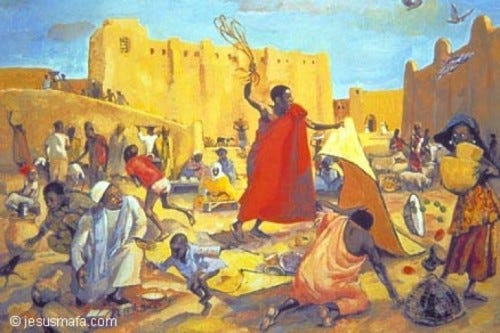
"Holy Week Art from Cameroon (Jesus Mafa)”
On reaching Jerusalem, Jesus entered the temple courts and began driving out those who were buying and selling there. He overturned the tables of the money changers and the benches of those selling doves, and would not allow anyone to carry merchandise through the temple courts. And as he taught them, he said, “Is it not written: ‘My house will be called a house of prayer for all nations’? But you have made it ‘a den of robbers.’” (Mark 11.15-17)
Today is the Monday of Holy Week, almost 2,000 years after the ancient Monday morning when Jesus walked into the Temple and forcably rearranged the furniture. Let’s step into the scene and look around.
The building must be an awesome sight for Jesus and his provincial, Galilean disciples. They’re seeing the building at its most magnificent, after forty years of King Herod’s ambitious building project. The wide-eyed crew will soon say, “Look, Teacher, what large stones and what large buildings!” (Mark 13.1) They’re in awe.
Jesus steps into this sacred site, where Israelites have come to meet God for most of a millennium, and calls it unholy. He throws some tables around and shuts down the whole economic operation. Then, to explain his actions, he shouts Isaiah’s words: “Isn’t it written, ‘My house shall be called a house of prayer for all the nations’? But you’ve made it a den of robbers.” It’s no wonder, when the priests finally arrest Jesus on Thursday night, that their first charge concerns the Temple. “We heard him say, ‘I will destroy this Temple that is made with hands, and in three days I will build another, not made with hands.’” (14.57-58)
Jesus mourns the yawning chasm between God’s intention for Israel’s holiest building and the merchandise show he sees in front of him. Sellers and money-changers exact whatever fee they wish for their services. Jesus knows something that you and I may not pick up. Poorer worshippers who wish to atone for their sins would not be able to afford the animals for sacrifice, because prices are gouged. That’s the issue. Jesus will abide no barriers between these worshippers and their God.
At our comfortable remove, it’s too easy to raise our righteous shout, “Go get ‘em Jesus! Give ‘em what they deserve!” Too easy to put Darth Vader clothes on the priests and see Jesus as Luke or Rey Skywalker. The stark line between good and evil looks obvious from the cheap seats.
But humility offers us a mirror. Those Jerusalemites of old were a lot like us. They had probably convinced themselves over time that they were doing God’s work as it should be done. They hadn’t noticed the gradual decline, the insidiously slow creep of greed, the insensitivity that had become normal over time. It took Jesus’s clear eye to see that something had gone terribly wrong. The same has been true across time. Slave-owners and the leaders of the Spanish Inquisition thought they were doing God’s will. And Christ-followers in our time — we who forget the poor now — need Jesus’s prophetic voices in our time to spot the evil we haven’t even noticed.
You and I do our best to be faithful, and we love our churches. But this Holy Monday scene offers a perfect chance to ask, “What would Jesus throw down if he walked in on my life? Or my church? What are the blind spots in my/our life?”
These are Holy Week questions, friends. Ask them as you walk this blessed day.
Prayer -- God, like the ancient guardians of your Temple, we can so easily lose our true north. Guide us, we pray. Give us lenses through which to see what ought to change in us, our church and the world. Guide us, we pray, in Jesus. Amen.